The Cutting-Edge F50 Catamarans of SailGP: Speed Meets Innovation
The SailGP series features F50 catamarans that redefine sailing with speeds up to 100 km/h, blending cutting-edge technology and thrilling competition.
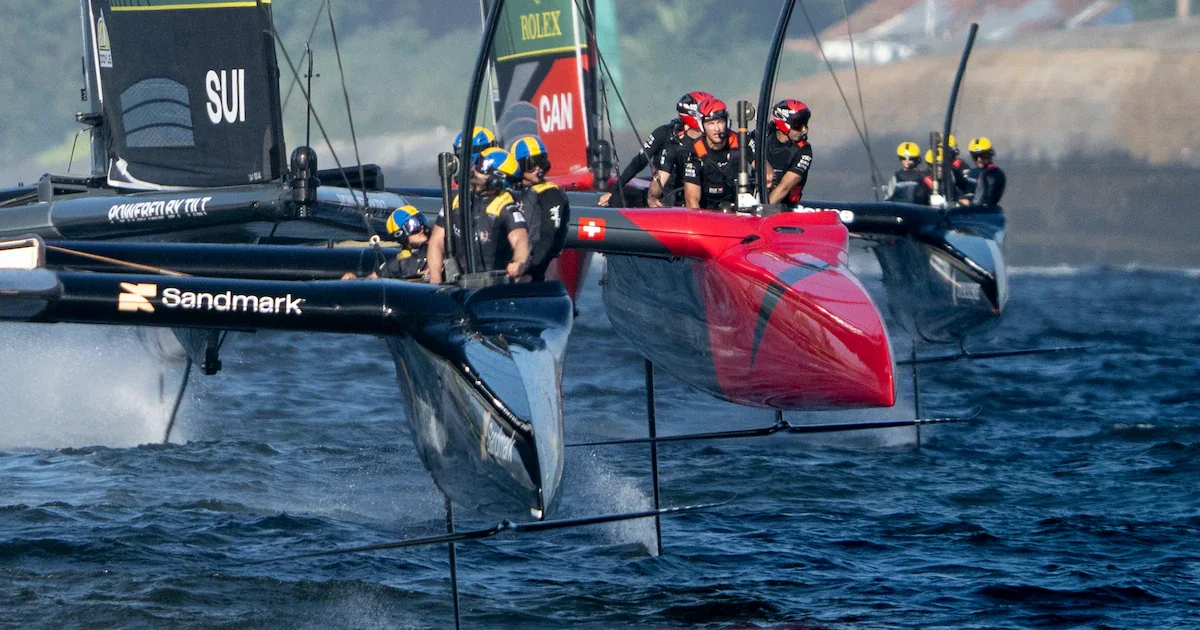
The world of sailing is undergoing a radical transformation, as evidenced by the SailGP series, where F50 catamarans soar across the water at speeds reaching up to 100 km/h. This competition blurs the lines between traditional sailing and high-tech innovation, redefining the sport in thrilling ways.
A serene coastal panorama sets the stage, with a gentle breeze tousling hair and the harmonious sounds of violins providing a tranquil soundtrack. Suddenly, a barely audible hissing noise breaks the calm. No engine roar or screaming gearbox is heard; just the wind. A boat rises from the water, appearing to hover.
In stark contrast, an electrifying guitar riff disrupts the peaceful atmosphere, as rapid cuts showcase the chaos of the sea. Water sprays everywhere as the catamaran not only hovers but begins to fly: welcome to SailGP!
SailGP: The Heavy Metal of Sailing
The F50 catamarans, featured in the Rolex SailGP Championship, skim a meter above the water's surface. What starts as a conventional sailing vessel transforms into a high-speed projectile. With top speeds exceeding 100 km/h, the F50s rank among the fastest sailing boats globally, outpacing even the wind.
Scheduled to take place in Germany on August 22 and 23 in Sassnitz, the Rolex SailGP Championship positions these boats as the focal point of a racing series that is revolutionizing sailing. If ordinary sailing resembles classical music, SailGP resonates with the sounds of heavy metal.
More Than Just Racing Vessels
The F50s are not merely impressive racing machines; they are floating laboratories of advanced technology, encapsulating a decade of development in high-performance sailing. They exemplify the intricate relationship between engineering, data analysis, and human precision.
,regionOfInterest=(436,386)&hash=ca78a622474915d73e4af0fc562e76d83a400e86cbbfc9ccaca7f33866edbc46)
Their specifications are impressive:
- The 15-meter-long catamaran spans nearly nine meters in width.
- A carbon wing towers up to 29 meters high above, resembling an airplane wing rather than a traditional sail.
- Weighing approximately 2.4 tons, the boat is valued at around 3.4 million euros.
The Magic of the F50 Catamarans
The real magic lies beneath the water's surface. Here, the hydrofoils—carbon wings—lift the boat out of the water at sufficient speeds. With only the slender foils touching the water, most of the resistance disappears.
The F50 accelerates to more than three times the wind speed. Achieving such flight is a continuous balancing act, managed by the flight controller, who finely adjusts the foils to regulate the boat's height above the water.
Just a few centimeters can determine whether the F50 glides smoothly or crashes back down. The boats behave like aircraft on a runway: they take off only when enough lift is generated.
When Water Starts to Boil
As speed increases, even the most advanced engineering faces physical limits. Beyond approximately 90 km/h, the water around the foils begins to "boil." This phenomenon, known as cavitation, creates tiny vapor bubbles that cause the rudders to vibrate, increasing resistance and complicating control.
,regionOfInterest=(510,390)&hash=14efba485946ddceec8fc535e5656a591bbbeeae01f6d1938591f817a45292fa)
Despite these challenges, the current F50s achieve speeds exceeding 100 km/h, thanks to a meticulously refined foil geometry that delays the onset of cavitation. The Danish team recently set a speed record of 103.85 km/h right before the Sassnitz event.
However, speed alone does not guarantee victory.
The Crew Wins the Race, Not the Boat
SailGP operates as a one-design class, meaning all 13 national teams race identical models. This crucial aspect ensures that the differences emerge on the water, not from the workshop.
The winning factor is not the largest development team but the most skilled crew. Success in the race hinges on expertise, teamwork, and split-second decision-making.
The boats are owned by the league, not the teams, with specialized technical crews managing electronics, hydraulics, foils, and wings. They prepare all F50s uniformly, ensuring identical conditions across the board.
Crew Must Function Like a Clockwork
The real fascination lies in the crew's ability to operate seamlessly. Six specialists must perform in perfect harmony, each fulfilling a specific role:
- The helmsman steers the boat using a steering wheel reminiscent of a racing car, equipped with ten buttons and two pedals.
- Behind the mast, the strategist monitors the competition, as the mast obstructs the helmsman's forward view.
- The flight controller keeps the boat airborne.
- The wing trimmer adjusts the massive carbon wing for optimal wind alignment.
- Two grinders provide the mechanical energy needed for systems and hydraulic functions through sheer muscle power. Every action must be precise, synchronized with the others.
,regionOfInterest=(458,373)&hash=15e6115ff36449e23ec8fc0dafe727fc9d78af1c5ff77735390b4966a3959757)
Simultaneously, the boat monitors itself. The F50 is a floating research laboratory, equipped with over 1,200 sensors that provide real-time data on stresses, speed, wind conditions, tilt angles, and foil settings. Teams can even track the setups that other crews employ during the race.
Few sports utilize data as effectively as those competing in this premier sailing league. Every course change, sail adjustment, movement, load shift, and minute correction is meticulously analyzed, often while the race is ongoing.
Wind conditions also play a critical role in determining victory. Consequently, the F50s feature modular wing sails of varying sizes. In strong winds, a smaller 18-meter wing is deployed for better control, while the largest variant, at 29 meters, provides maximum thrust in lighter winds. This adaptability allows the boats to adjust to changing conditions without compromising their performance.
24 Razor Blades on the Water
Despite all the technology, F50s remain uncompromising racing machines. They are as ill-suited for rough seas or long voyages as jet fighters are for commercial air travel or race cars for farmland.
Even small waves can disrupt their flight and cause significant damage.
,regionOfInterest=(1895,2224)&hash=8687268dff196d1ad83164bef23d3ecbab9318addf4d4d3eb7beb9f77bad4121)
The dangers extend to the crews themselves. As the F50s speed up, the forces aboard become increasingly intense. Professionals don neoprene suits along with protective vests, helmets, safety harnesses, small oxygen supplies, and knives for emergency situations to free themselves from lines. The razor-sharp foils pose a particular threat, as twelve boats slice through the water with 24 carbon wings at high velocity.
When Boats Suddenly Take Flight
This delicate balance between maximum control and potential loss of control is what makes the F50s so captivating. They are not just sailing vessels; they are race cars, airplanes, and research platforms all in one.
As the F50s glide silently over the Baltic Sea near Sassnitz at the end of August, it may appear effortless. However, each flight is the result of a complex interplay of engineering, sensor technology, muscle power, and perfect reflexes.
Wind transforms into speed, water becomes a runway, and sailing boats evolve into racing machines that showcase the future of water racing.