Youth Academy FC 26: Cultivating Young Talent for Career Success
Mastering Career Mode in FC 26 involves leveraging the Youth Academy, a strategy that yields professional-quality players at no cost. This guide outlines how to maximize your academy's potential.
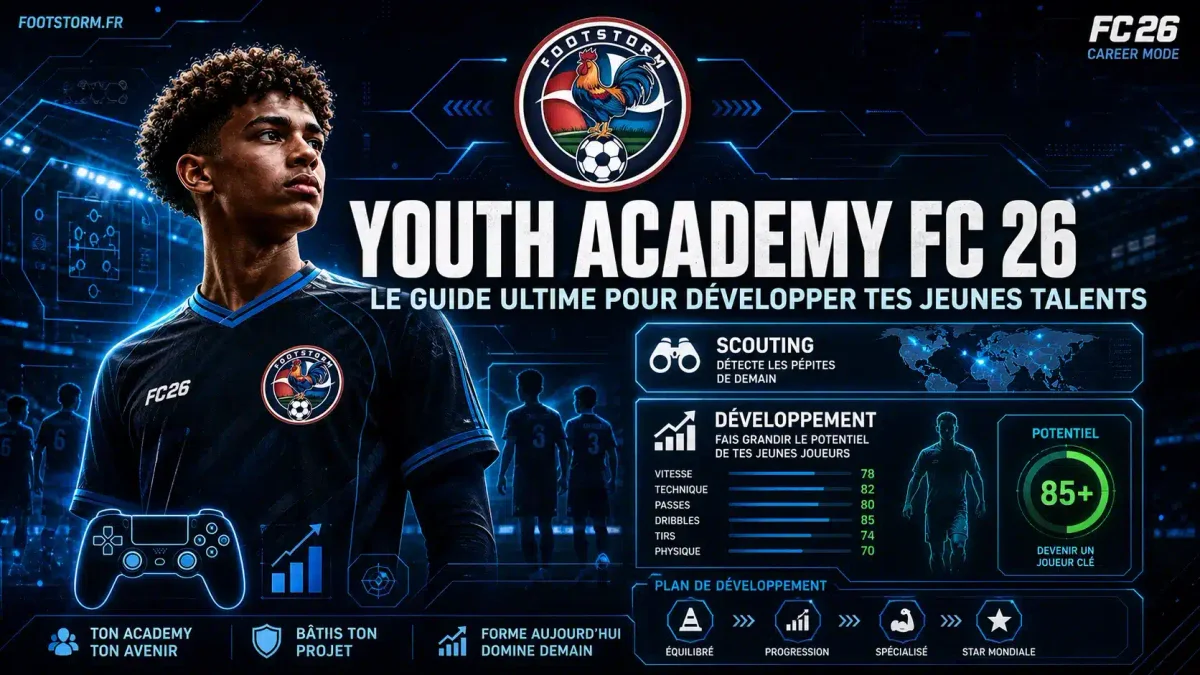
To truly excel in Career Mode FC 26, there's a crucial insight that top managers understand: the Youth Academy is the most profitable investment in the game. While a transfer for €80 million nets you just one player, a well-managed Youth Academy can provide 5 to 10 professional-quality players, completely free, for entire seasons.
However, this is not a strategy for those seeking immediate results. The Youth Academy in FC 26 requires vision, planning, and meticulous resource management. In this comprehensive guide, we’ll break down each step to transform your training center into a talent-producing machine — building a team of champions without spending a dime in the transfer market.
1. Why the Youth Academy FC 26 is Overpowered (OP)
Before diving into the technicalities, it's essential to grasp why this mechanic is a game-changer in Career Mode.
No Acquisition Costs
Unlike transfers, where each player costs millions, talents from your Youth Academy arrive for free. You save not only on transfer fees but also on agent commissions and solidarity payments.
Enormous Growth Potential
A young recruit at 16 with an overall rating (OVR) of 65-70 can reach 85+ within just 3 to 4 seasons with proper training. This kind of progression is rarely found at reasonable prices in the transfer market.
The Homegrown Bonus
Homegrown players offer significant strategic advantages:
- Lower Salaries: A homegrown player will accept much lower wages than a star signing from the market.
- Greater Loyalty: There’s less risk of them leaving and less pressure for costly renewals.
- Registration Benefits: In certain competitions (Champions League, Premier League), having a quota of “homegrown” players can be crucial for your squad composition.
In summary: The Youth Academy FC 26 is the difference between a club that spends and one that builds an empire.
2. How the Youth Academy Works: The Complete Flow
Managing an effective Youth Academy follows a precise cycle. Here’s each step, detailed and optimized.
Step 1: Upgrade Your Facilities (Year 1)
This is the foundation of it all. Without quality infrastructure, even the best young talents will stagnate.
Recommended Budget
- €50,000 to €100,000 per season for the first three seasons.
- This budget should be prioritized over external signings, even if you miss out on a “bargain” in the market.
Upgrade Priorities
| Installation | Priority | Impact | |------------------------------|----------|----------------------------------------------------| | Youth Academy Facilities | ⭐⭐⭐ | Determines the speed of youth progression | | Coaching Staff | ⭐⭐⭐ | Direct bonus on stat growth | | Scouting Network | ⭐⭐⭐ | Access to the best talents worldwide |
Pro Tip: Don’t overlook the coaching staff. Specialized youth development coaches can accelerate progression by 20 to 30%.
Step 2: Scouting — Finding Gems
Scouting is the most strategic step. A good scout can save you millions… and seasons of unnecessary development.
Ideal Profile of Young Players to Target
- Age: 16 to 21 years (the younger they are, the higher their potential for growth).
- Potential: Minimum 75+ (ideally 80+ for key positions).
- Priority Positions: Center-back, central midfielder, forward — positions where transfers are most expensive.
Scouting Strategy
- Send your scouts to high-potential areas: Brazil, Argentina, France, Germany, Spain, Netherlands.
- Mission Duration: Favor 3-month missions for a good balance between accuracy and speed.
- Filter Reports: Immediately ignore players below 70 potential. Focus on “Exciting Prospect” and “Has Potential to be Special.”
Internal SEO Tip: If you’re looking for specific guides by position, check out our upcoming analyses on regional scouting at footstorm.fr.
Step 3: Development — Nurturing Your Talents
Once your youth are in the academy, their progression hinges on four key factors:
The 4 Pillars of Development
- Training Time at the Academy: The longer a player stays in the academy, the more they progress… but be careful not to hold them back too long without matches.
- Quality of Coaching Staff: Having 4.5-star coaches in youth development = optimal growth.
- Quality of Facilities: Maxed-out facilities = constant progression bonus.
- Match Experience: This is the most underestimated factor.
The Importance of Matches for Young Players
A young player who doesn’t play stagnates. Here are the two options:
| Option | Advantages | Disadvantages | |-----------------------|---------------------------------------------------|--------------------------------------------| | Loan | Competitive matches, rapid progression, experience gain | You can’t control their development, injury risk | | Academy Matches | You control everything, no loan risks | Less competitive, slightly slower progression |
Recommendation: Loan your young players as soon as they reach 70+ OVR to lower-division clubs where they will be starters. This is the best progression accelerator.
3. Realistic Timeline: From Academy to First Team
Here’s a typical timeline for an optimized Youth Academy:
Year 1: Foundation
- Objective: Max out facilities.
- Budget: €100,000 invested in infrastructure.
- Action: Launch the first global scouting missions.
- Expected Result: 3 to 5 young talents identified with 75+ potential.
Year 2: First Harvest
- Objective: Integrate the first promising young players.
- Action: Loan out players with 70+ OVR, develop others in the academy.
- Expected Result: 1 or 2 young players reach 80+ OVR and can join the first team bench.
Years 3-4: The Acceleration
- Objective: Build a core of young talents.
- Action: Rotate between the academy and loans, manage promotions to the first team.
- Expected Result: 3 to 5 players at 80-85 OVR ready to be quality starters or substitutes.
Year 5: Domination
- Objective: A nearly free top-level team.
- Expected Result: 5 to 10 “homegrown” players at 85+ OVR integrated into your squad.
- Financial Impact: You’ve saved the equivalent of €400 to €800 million in transfers.
Final Result: A competitive, young, loyal, and cohesive team — all without spending a single euro in the transfer market.
4. Common Mistakes to Avoid with the Youth Academy FC 26
Even the best managers make mistakes. Here are the most common pitfalls:
❌ Neglecting Facilities
Want immediate results? Wrong approach. Without maxed-out facilities, your young players will progress at half the speed.
❌ Keeping Young Players Too Long in the Academy
A player at 21 who has never played professionally stagnates. Get them out, loan them, let them play.
❌ Scouting Without Strategy
Sending scouts randomly = wasting time and money. Target specific positions and high-yield regions.
❌ Ignoring the Coaching Staff
Generalist coaches are not enough. Hire youth development specialists, even if their salaries are higher.
What is the best age to recruit a young player? → 16 years is ideal. The earlier you take them, the more you can shape their progression.
How many seasons does it take for a young player to reach 85+ OVR? → On average, 3 to 4 seasons with maxed facilities and regular playing time.
Is it better to loan or keep in the academy? → Loan out once they reach 70+ OVR to a club where they will be starters. This is the best accelerator.
Does the Youth Academy work with all clubs? → Yes, but clubs with a better initial budget (Premier League, La Liga, Bundesliga) can upgrade faster.
6. Conclusion: Patience + Strategy = Domination
The Youth Academy FC 26 is not a short-term strategy. It’s an investment that requires vision, discipline, and patience. But the return on investment is unmatched:
- €0 spent on transfers
- A team of 85+ OVR
- Loyal and affordable players
- Sustainable competitive advantage
By year 5, you won’t view the transfer market the same way. You will have built something far more valuable: an empire.