
How Estonia's Public Broadcaster ERR Prepares for Possible Attacks from Russian Aggressors
A delegation from Public Broadcasting visited colleagues at ERR. Since the beginning of Russia's full-scale invasion, we have felt even greater support, especially on an international level.



A delegation from Public Broadcasting visited colleagues at ERR (Estonia's public broadcaster) at the end of May. ERR has always supported us since the establishment of NSTU. Since the beginning of Russia's full-scale invasion, we have felt even greater support, especially on an international level.

Estonians constantly refer to themselves as a small country. Indeed, Estonia is one of the least populated countries in the European Union – with over 1.3 million people. However, like Ukraine, they have a troublesome neighbor – the Russian Federation. Russia considers Estonia, like all independent countries that emerged after the collapse of the USSR, as "non-countries" and treats it with disdain.
We observed that this does not intimidate the Estonians; they are already preparing for war. According to the results of the latest survey commissioned by the Estonian Ministry of Defense, over 60% of Estonians, and nearly 70% among ethnic Estonians, are ready to defend their country within their capabilities.

ERR is also preparing for a possible attack from Russian aggressors. The company's management visited Ukraine several years ago to study the experience of Public Broadcasting during wartime. However, considering the country's specifics, the broadcaster developed its own emergency protocols. Negotiations were held with public broadcasters from other countries, including Sweden, Latvia, and Lithuania. There are already certain agreements for support. Training sessions for working in extreme conditions were also conducted, which allowed them to refine their actions in case of danger. In short, the focus is on disseminating information digitally and via radio.
Regarding personnel, the company has also identified a critical minimum of people who will produce and disseminate important content if the central office "goes down." This is about 300 individuals.
In total, ERR employs just under 600 people, with several hundred more working as freelancers. ERR – Eesti Rahvusringhääling was established 10 years before NSTU on June 1, 2007. The company was formed as a result of the merger of two state institutions: Estonian Television (ETV) and Estonian Radio. It has a budget of 49 million euros.

We were curious whether the company is involved in the fight against disinformation. ERR consists of three television channels, five radio channels, a digital platform, and a VOD service. Among them is the Russian-language channel ETV+ and the radio channel Raadio 4. Estonia decided to create them to convey the pro-Estonian position to Russian-speaking citizens. The company's website can also be read in Russian.
Additionally, ERR launched a media literacy project. As the heads of ERR's Russian-language resources told us, they currently do not have specific projects dedicated to disinformation, although there was previously a program on Raadio 4. "We consider our audience to be intelligent, provide them with truthful information, and believe that they will figure it out,” they said.
Of course, not everyone will figure it out. We met a pro-Russian citizen of Estonia who was born in this country. According to him, Estonia has betrayed Russia. He considers the USSR and Russia to be one country. It turned out that he watches news from Russian television channels. And although he despises Estonia and Estonians, even calling them indecent names, he does not intend to leave this country because he was born here.
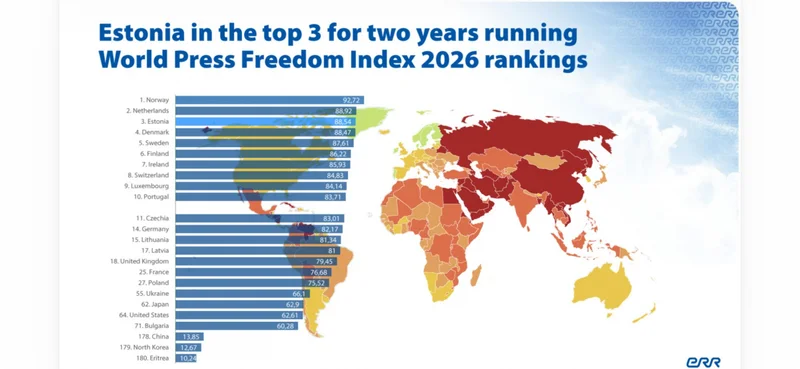
Let me remind you that Estonia ranks third in the Press Freedom Index for 2026. This has been facilitated by the country's public broadcaster. ERR's content, especially news, has a high level of audience trust.